A Heart Attack, Backward — Part 4 of 4: Where does periodontal disease enter?
Where periodontal disease enters the story: what the associations can show, what the treatment trials have established, and what a hygienist can honestly say in the chair.
In 1910 a London physician named William Hunter told an audience at McGill that the mouth was a reservoir of sepsis, and that a great deal of chronic illness could be traced to it. Within a few years the idea had a name, focal infection, and a treatment. Dentists and physicians pulled teeth by the mouthful. Healthy teeth went too, on the theory that a hidden infection was better removed than missed.
By the end of the 1930s the critics had done the arithmetic. Patients who lost their teeth did not get better. The theory collapsed, and with it went most of the medical profession's interest in the mouth for the next half century. The pendulum swung all the way back to 1840.
I bring this up because the series has been walking toward exactly the claim Hunter made, and I want us to arrive at it with better instruments than he had.
Three letters ago we started with a clot. Then we opened the plaque beneath it. Last week we let the blood move, found the endothelium talking to the muscle around it, and followed nitrate from the tongue into the circulation.
Now the question the whole series has been saving. Where does periodontal disease enter, what can the evidence show, and what can it not?
If you missed it, Part 3 covers pressure, flow, and mouth chemistry.
First, describe the lesion in the terms we have been using
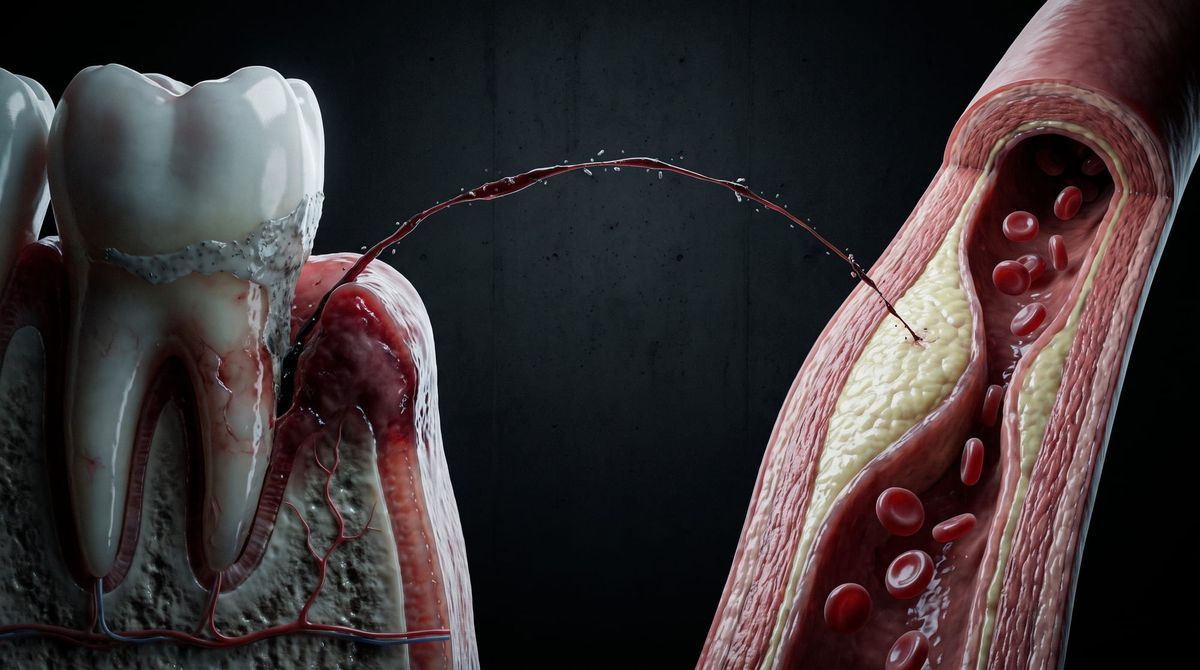
A periodontal pocket is a wound that does not close. Along the root surface sits a bacterial biofilm. Facing it, a few cells thick, is pocket epithelium that is often ulcerated. Behind that epithelium is inflamed connective tissue with its own blood supply. Add up every pocket in a mouth with generalized periodontitis and you have a considerable area of inflamed tissue in continuous contact with a bacterial community.
That is the anatomy. It gives us three plausible routes from the mouth to the artery, and each one can be tested separately.
Route one: the bacteria travel
Bacteremia after dental procedures has been documented for decades. What is easy to forget is that it does not require a procedure.
Lockhart and colleagues sampled blood from volunteers after toothbrushing and after a single extraction. Brushing alone produced detectable bacteremia in a substantial minority of participants. Extraction produced it in a majority. The organisms were oral, and poorer gingival health was associated with higher rates. Lockhart and colleagues, 2008
So the bacteria do reach the blood, and in people with inflamed gums they reach it routinely. Whether any of them reach the artery wall and do something there is a separate question.
Haraszthy and colleagues looked for the DNA of periodontal pathogens in carotid plaques removed at surgery. They found at least one such organism in a little under half of the fifty specimens. Haraszthy and colleagues, 2000
Hold that result carefully. Detecting bacterial DNA in a plaque shows that material from the mouth can end up in the wall. It does not show that the organisms were alive, that they arrived before the plaque formed, or that they changed its course. The finding is a reason to keep investigating, not a verdict.
Route two: the inflammation is systemic
In Part 2 we met the cells and signals that keep a lesion active inside the wall. Periodontitis adds to the body's inflammatory load from a distance, and the usual way to see that load is C-reactive protein, or CRP, in the blood.
A systematic review and meta-analysis found that people with periodontitis have higher circulating CRP than people without it, and that periodontal treatment is associated with a modest reduction. Paraskevas and colleagues, 2008
D'Aiuto and colleagues showed the treatment effect directly. Controlling the local infection was followed by lower serum CRP and interleukin-6 in the months afterward. D'Aiuto and colleagues, 2004
Schenkein and Loos reviewed the candidate mechanisms in detail: bacterial products entering the circulation, inflammatory mediators produced in the gingiva, and immune responses to oral bacteria that cross-react with the body's own proteins. Each has laboratory support. None has been shown to be the operative one in a human coronary artery. Schenkein and Loos, 2013
The inflammation route is the one most researchers consider plausible. It is also the hardest to pin down, because so many other things raise CRP.
Route three: the vessel wall responds
This is where Part 3 pays off.
Tonetti and colleagues randomized 120 patients with severe periodontitis to intensive periodontal treatment or to community care, and measured flow-mediated dilatation of the brachial artery, a standard test of endothelial function. The result came in two acts. In the first day after intensive treatment, inflammation markers rose and endothelial function got worse. By six months, endothelial function in the treated group was better than in the control group, and the improvement tracked with how much the periodontal condition had improved. Tonetti and colleagues, 2007
Read that alongside last week's letter. The endothelium is the layer that makes nitric oxide and tells the muscle to relax. Here is a randomized trial in which treating the mouth changed what that layer did in the arm.
It is a real result and a limited one. Flow-mediated dilatation is a measurement of vessel behavior. It is not a heart attack prevented.
What the associations can show
Put the routes aside and ask the plain epidemiological question. Do people with periodontitis have more coronary disease?
They do, consistently, by a modest margin. A meta-analysis of cohort studies found roughly a 14 percent higher risk of coronary heart disease in people with periodontitis, with larger estimates in case-control designs. Bahekar and colleagues, 2007 A systematic review for the U.S. Preventive Services Task Force reached a similar conclusion, with relative risks in the range of 1.2 to 1.3 depending on how periodontal disease was measured. Humphrey and colleagues, 2008
The two diseases share risk factors: smoking, diabetes, age, and the social conditions that travel with both. The studies above adjusted for the ones they could measure. Residual confounding is the standing objection, and it is a fair one.
In 2012 the American Heart Association reviewed the whole literature and wrote its conclusion in two sentences that are worth memorizing. Observational studies support an association between periodontal disease and atherosclerotic vascular disease independent of known confounders. They do not support a causative relationship. Lockhart and colleagues, 2012
Eight years later, a joint workshop of the European Federation of Periodontology and the World Heart Federation reviewed the newer evidence and kept the same shape: an independent association, a plausible biology, and a recommendation that cardiologists and dental professionals talk to each other about shared patients. Sanz and colleagues, 2020
An association of that size is real. It is also smaller than the effect of smoking, and it does not tell a hygienist whether the patient in the chair will have a heart attack.
What treatment studies can establish
The strongest form of evidence would be a trial: treat periodontitis in people at risk, leave a comparison group untreated or on usual care, and count cardiovascular events for years.
That trial has been attempted once, as a pilot. The Periodontitis and Vascular Events study enrolled about three hundred people with established coronary disease and randomized them to periodontal therapy or community care. It was designed to test feasibility, and it did. It was not large enough to detect a difference in events. Many participants in the community-care group sought periodontal treatment on their own, which blurred the comparison. Offenbacher and colleagues, 2009
A Cochrane review in 2019 searched for every trial of periodontal therapy with cardiovascular outcomes and concluded that the evidence was insufficient to say whether treatment prevents events in people with or without existing heart disease. Liu and colleagues, 2019
Observational data point in an encouraging direction. In a Korean cohort of nearly a quarter of a million adults, more frequent toothbrushing and regular professional cleaning were each associated with lower rates of cardiovascular events over about a decade. Park and colleagues, 2019 The design cannot separate the habit from the kind of person who keeps it.
There is one place where periodontal treatment has cleared the bar of a clinical outcome, and it belongs in this letter because the outcome is itself a cardiovascular risk factor. In people with diabetes, periodontal treatment lowers HbA1c by roughly 0.4 percentage points at three to four months, a result the Cochrane reviewers rated with moderate certainty. Simpson and colleagues, 2022
That is a chain, not a shortcut. Treating the mouth improves glycemic control. Better glycemic control is good for arteries. The link from periodontal treatment to fewer heart attacks still has to be measured on its own.
Bring the pieces back to the chair
Here is what the evidence lets a hygienist say to a patient, and what it does not.
You can say that gum disease and heart disease travel together more often than chance would predict, and that the reasons are being studied. You can say that treating periodontitis lowers inflammation in the blood and improves how blood vessels behave in the months afterward. You can say that in people with diabetes it improves blood sugar control.
You cannot say that treating gum disease will prevent a heart attack. Nobody has shown that, and the one trial that tried was too small to tell.
Notice that the honest version is still a strong reason to treat. Periodontitis destroys the tissues that hold teeth in the jaw. It is a disease worth treating on its own terms, and the systemic findings are a reason to treat it sooner and to coordinate with the physician when the patient smokes, has diabetes, or already has heart disease.
That coordination is the point of these letters. Hunter's generation claimed too much and pulled teeth. The generation after him claimed nothing and stopped looking. The way back from 1840 is neither. It is a hygienist who can describe exactly what is known, and a physician who will listen.
Back to the clot
We walked this backward. Now walk it forward once.
A bacterial community in a pocket. An inflamed wound that does not close. Bacteria and mediators that enter the circulation with every meal and every brushing. An endothelium that behaves differently when the mouth is treated. A wall that retains particles, loses the ability to clear its dead, and builds a plaque. A surface that fails, a clot that forms, and a piece of heart muscle that goes quiet.
Every step in that sequence has evidence behind it. The arrows between some of the steps are drawn in pencil. Our job is to know which ones.
What do your patients with heart disease ask you about their gums? Please leave out names and identifying patient details.
— Thad
For the next team huddle: Name the three routes from the mouth to the artery. Then state, in one sentence each, what the association studies show and what the treatment trials have not yet shown.
The four-part series:
- Start with the clot.
- What was in the artery before the clot?
- Pressure, flow, and mouth chemistry.
- Where does periodontal disease enter? This letter.
If this helped, pass it to a hygienist you work with.